


I was a teenager the first time I tried LSD and mescaline. Tim Leary had sent a dozen disciples out to evangelize the world and a guy named Keith St. Clair showed up at The Paper office (the MSU underground newspaper; I was living there) with a box full of Owsley acid and cactus buttons.
It was 1967 and this was all entirely legal; Henry Luce, who owned TIME and LIFE magazines and was an anti-communist Republican, had taken it himself in 1960, as had his wife Clare Luce Booth, who credited it with saving their marriage. He announced it to a ballroom full of stunned colleagues in a New York hotel in 1964 and it shook the media.
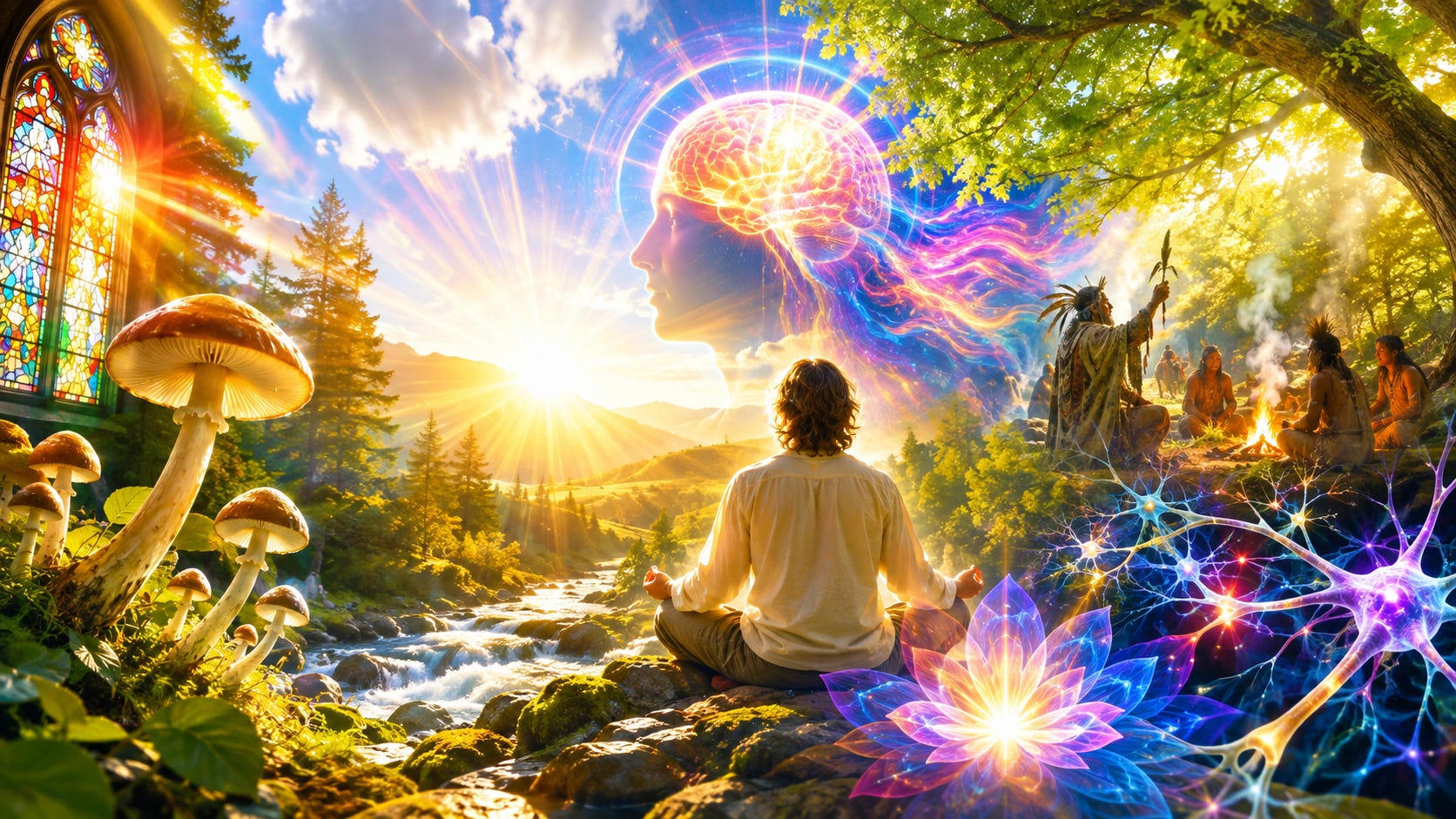
A local pastor let us use the sanctuary of his church (“set and setting are critical,” Keith said) and we tripped to stained glass windows, a 33 RPM LP of Leary telling us to “Turn on, tune in, and drop out” as he explained what that meant, and music from that same portable record player ranging from Ravi Shankar to Gregorian Chants.
It changed my life. I discovered that the reality I’d grown up in, the one my parents, school, and country agreed on, wasn’t the only one available to me; it sent me on a lifelong spiritual search. As William James wrote in 1909 of his own psychedelic experience:
“...our normal waking consciousness, rational consciousness as we call it, is but one special type of consciousness, whilst all about it, parted from it by the filmiest of screens, there lie potential forms of consciousness entirely different. We may go through life without suspecting their existence; but apply the requisite stimulus, and at a touch they are there in all their completeness. …
“No account of the universe in its totality can be final which leaves these other forms of consciousness quite disregarded. How to regard them is the question, for they are so discontinuous with ordinary consciousness. Yet they may determine attitudes though they cannot furnish formulas, and open a region though they fail to give a map. At any rate, they forbid a premature closing of our accounts with reality.”
Which is why I’ve been following the psilocybin (I tried that, too, a few years later) drug trials. I know from personal experience that I wasn’t the only person whose life was changed for the better by this experience, and now these studies are backing that observation up.
A company called Compass Pathways has developed a synthetic psilocybin (the “magic mushroom” chemical) and just finished Phase 3 trials on nearly 600 people with treatment-resistant depression (depressive episodes that had lasted 3 years or more and no drug or therapy had helped). The benefit appeared the very next day after their first dose, and was still just as strong 26 weeks later.
They hope to have FDA and DEA approval by the end of this year so it may be clinically available by the end of next year. And the feds are moving fast on this, based on an executive order this April telling them to speed things up.
I remember several of the trips I took after that first one where I was alone for the entire few hours and just sat in silence, in awe of the world around me. One of my favorites was sitting in the deep forest with a large stream running through it across the street from The Paper office. I was transported back to neolithic times; the memory is still vivid.
And that’s what they found in these trials, too. In fully 78 percent of the six-hour psilocybin sessions the study subjects simply chose to sit in complete silence. Their “providers” were there, available, like Keith had been for me on my first trip, but most people simply wanted to savor the new world the drug had opened up for them.
The company’s chief medical officer, in a paper titled “Silence is golden,” argued that this wasn’t “psilocybin-assisted psychotherapy”; instead, he said, the improvement in people’s depression came exclusively from their own internal experience. The single most therapeutic thing the trip-helpers did was to stay out of the way and keep their mouths shut.
In the years since, I’ve participated in psychedelic ceremonies with indigenous people on three continents: this “revelation” that St. Clair and James and Luce experienced (and me, too!) has been well-known to humans since the most ancient of times.
As I noted back in 2021 on HartmannReport.com:
“For millennia across the European arctic circle around the North Pole, from Scandinavia through Siberia, indigenous shamans sought out red-and-white mushrooms (amanita muscaria) and dried them in socks hanging from their fireplaces.
“The mushrooms contain a powerful psychedelic, Muscimol, but are also laced with compounds poisonous to humans. Reindeer, however, love to eat these mushrooms and, when they do, they behave oddly, as if their names were Dancer and Prancer.
The reindeer love the taste of the mushrooms, and their livers detoxify the poisons in amanita while letting the Muscimol pass through untouched, so the shamans would collect their urine in fresh snow and make it into a powerful drink that gave them visions of tiny men and the feeling that they could fly.
On the longest night of the year they’d set a pine tree on fire to reignite the sun, take their drink, and fly up to the spirit world to help the sun return. The mushrooms are red with white dots and trim on the edges, rotund, and look like little miniature Santas. We didn’t lose that ceremony, we merely secularized and modernized it into what we today call Christmas.
A few weeks ago I wrote about why and how the NLP technique of reframing works and that new brain science connects our minds to a universal mind, a common experience on psychedelics. This is apparently what happened to these people who were treatment-resistant depressed; nobody talked them out of their depression or showed them new strategies or ways of thinking. They simply discovered their solutions on their own as the world opened up for them.
It’s important to note that this isn’t for everybody. I was 16 and going to college when I took LSD, but today I’d never recommend it to anybody too young to drink alcohol. And studies over the decades suggest it can be downright dangerous for people with psychosis in their family history.
I had a wise teacher who guided me in Keith; this isn’t something to do on a lark or recreationally. One of the things I really, really learned from the shamans I’ve tripped with is that this is powerful, deeply sacred, and should only be used with the most serious intent, be it therapeutic or spiritual.
The FDA is holding a public hearing on September 14th in Silver Spring, Maryland about psychedelic treatment in supervised settings and whether it should be more generally allowed. If you have strong opinions or personal experience on the subject, you may want to let them know your thoughts.
And tell our community in the comments section your experiences and thoughts on all this.
Just because we have not traveled to a different consciousness does not mean it doesn't exist. Consciousness has no boundaries. The awe one feels when consciousness is unleashed is typically very healing to our psyches. I hope for people in need that they can discover good solutions in this.
I was miffed with life. ☹️
Mushrooms 🍄 led me to understand ALL IS ONE.
Since then I have been content. 🧘🏻♀️
And have no fear of death ☠️
https://substack.com/@nature007/note/c-330763309?r=3le9sh&utm_source=notes-share-action&utm_medium=web