


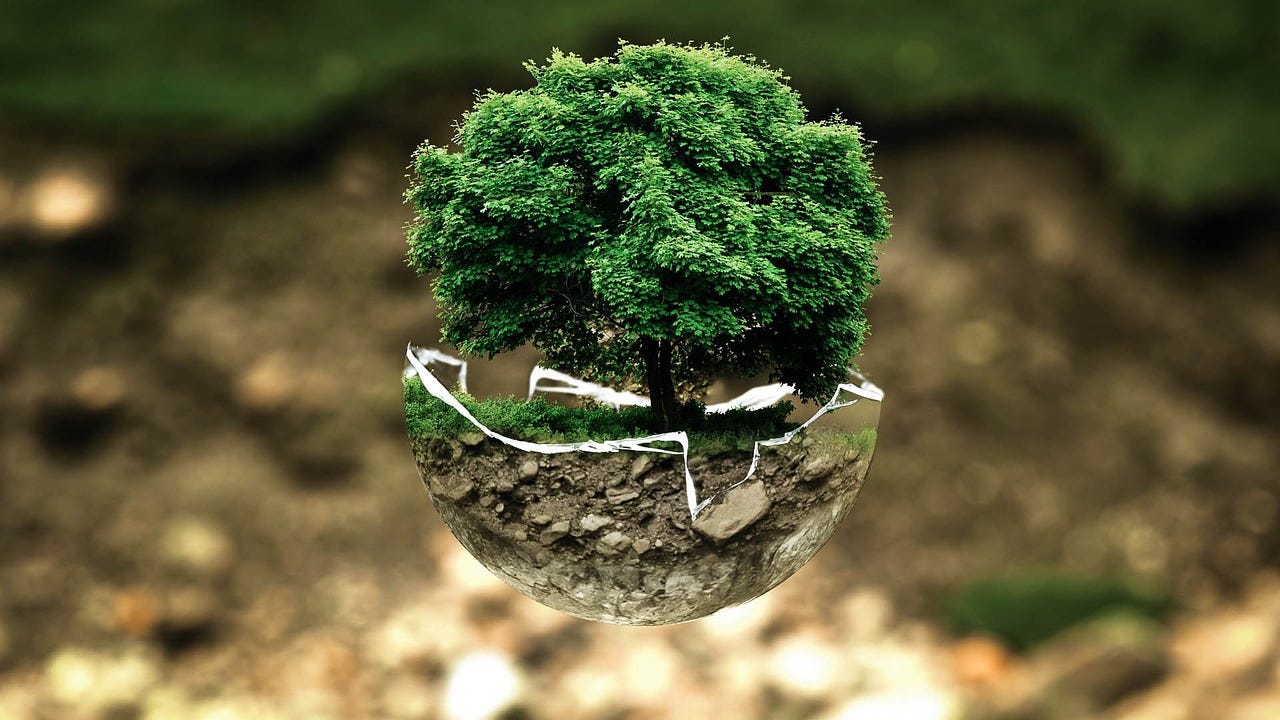
Herr Mueller had a tree.
He was my teacher when I was a young man in Germany, the man I wrote about in The Prophet’s Way, and nearly every day I lived in or visited him in Stadtsteinach we’d take a walk through the mountainous forest of the Frankenwald that went past an enormous old pine. He’d stop, hold his open palms against its bark, press his cheek to the tree, and talk to it.
He told me he was exchanging energy with the tree and that it kept him young and strong, something he said Europeans had been doing for millennia. He said I should build a relationship with the plants and trees around me, that they were our sentient neighbors and not just scenery.
I was in my twenties and I nodded along the way you do with a teacher you love, never quite sure whether he meant it literally.
The year after he died, so did that two-hundred-year-old tree. I still remember my shock when I came upon the stump and wreckage while visiting my old haunts.
I’m reminded of that tree a lot these days, as Herr Mueller’s view of the plant kingdom has broken into the open in the scientific journals, and it’s getting nasty.
The Guardian ran a long article earlier this month on what it called the “bitter debate” over whether organisms without brains can think, and the headline essentially quoted a skeptical scientist who’d called the whole line of inquiry dangerous.
The creature at the center of this particular fight is a slime mold called Physarum polycephalum, a single yellow cell that can spread to the size of a dinner plate and has no brain, no neurons, and nothing you’d recognize as what we’d call a nervous system.
But then came along Japanese researcher Toshiyuki Nakagaki, who showed it could find the shortest path through a maze to reach a pile of oat flakes. His team later laid out their oats in the pattern resembling Tokyo and its suburbs and watched the mold grow a network that closely matched the region’s actual rail system, and arguably improved on it.
Stranger still, when researchers blew cold, dry air at a mold once an hour for three hours, it slowed down movement on its own at the fourth hour, bracing for a gust that never came. Nobody knows how a slime mold keeps time. And biologist Chris Reid found that the slime trail the organism leaves behind also works as a kind of external memory, telling it where it’s already been so it doesn’t waste effort going back.
More complex plants have their own version of this story. A 2018 study in the Annals of Botany found that ordinary anesthetics stop plants in their tracks. Venus flytraps quit snapping, Mimosa leaves quit folding, pea tendrils quit curling, and when the drug wears off they start again, just like you and I would do after surgery. Whatever the anesthetic is switching off — what we always assumed was the nervous system responsible for what we call consciousness — plants have it too.
Nobody’s disputing the science here; the mold solves the maze, the flytrap goes under, and the oak does, in some sense, decide. The argument roiling the scientific community is about which words we’re allowed to use for these behaviors, and whether they have something — anything — that resembles what we call consciousness.
The philosopher Pamela Lyon calls the broader view encompassing plant consciousness as being “biogenic,” the idea that cognition is a property of life itself rather than a late upgrade reserved for animals, and she told the Guardian she thinks a Copernican shift is on its way that will transform the way we understand life and consciousness.
Our ancestors didn’t need that shift: they started there. Around the year 723, the missionary Boniface took an axe to Donar’s Oak, a tree the Germanic tribes of Hesse held sacred, and used the wood to build a chapel. Since that tree had been held sacred by pagans, his goal was, in part, to prove that it was “only wood.”
The people who’d been talking to that oak for generations — like the Celts in their groves, the Shinto priests who still tie ropes around ancient cedars, and virtually every Indigenous culture I’ve ever spent time with — would’ve told Boniface he had it backwards. Herr Mueller, a Christian to his core, had connected deeply and daily to what that oak’s people knew.
It turns out he may have been onto something that even a skeptic can measure.
Qing Li, an immunologist at Nippon Medical School in Tokyo, has spent two decades studying what the Japanese call shinrin-yoku, also known as “forest bathing.” In his best-known experiment, twelve men spent three days walking in the woods, and their natural killer cell activity, a frontline immune defense against viruses and tumors, rose sharply and stayed elevated for more than a week.
When the same men walked the same distance through a city, however, they got no such boost. Li’s leading suspect for the way trees can influence the biology of humans is a group of proteins called phytoncides, the aromatic compounds pines and cedars release to defend themselves, which people breathe continuously while walking in a forest.
“Exchanging energy with the tree keeps me strong” doesn’t sound nearly as mystical to me now as it did when I was twenty-something.
I have a tree of my own. It’s on a walk I take several times a week, and when I get to it I do what Herr Mueller did. I don’t know whether the tree knows I’m there or not, but neither does anyone at Oxford or Murcia or Macquarie. But I’ve had pain in my back ever since a skydiving accident when I was 19, and every time I visit my tree it goes completely away for a few hours. Placebo effect? Maybe…
I’ve decided I’d rather err on the side of the older cultures and Herr Mueller than on the side of the Cartesian missionary with the axe.
So find your tree. Pick one on a route you already walk, and stop to touch it, sharing energy with it, even talking to it. Do it every time you pass the tree and remember to.
Give it a season, and then notice what’s changed, not in the tree, but in you. I’ve shared this with a few dozen people over the years, and based on their experiences I suspect you’ll be pleased with your own results.
A very large Maple tree I call the "Matriarch", lives in my front yard. She knows I adore her because I tell her. And she wears the many ribbons I place upon her branches as an adoration returned. I have placed these ribbons to honor people that have been killed or harmed. Some I know, some are unknown strangers. She's my "in memory of" Honor Tree. I simply feel better near trees. And she knows it.
I am Delighted to know you have a tree, Thom. Thank you for straddling the worlds of politics, science and ancient knowing, so brilliantly and beautifully.