


The World Health Organization released a report last June that deserves far more attention than it got. One in six people on the planet, they found, is now affected by loneliness. It kills an estimated 871,000 people every year, more than 100 every hour, every hour of every day.
The Commission that produced the report called social disconnection “a defining challenge of our time” and drew a roadmap for governments and communities to respond. The usual proposals followed: more parks, better public transit, tech companies designing for connection rather than engagement, a minister of loneliness here, a national strategy there.
These are not bad ideas. But they’re solutions to a problem that’s being described incorrectly, and when you describe a problem incorrectly, your solutions tend to work at the edges rather than at the root.
The framing we keep reaching for treats loneliness as a malfunction, something that has gone wrong in an otherwise healthy social system. But what if loneliness at this scale is not a malfunction at all?
What if it’s the entirely predictable result of an experiment in how to organize human life that we’ve been running for about ten thousand years, and the results are now coming in?
I spent time in South Sudan in 2008, near the Darfur border, in a refugee settlement of 45,000 people who’d fled bombardment, rape, mass murder, and forced displacement. The conditions were severe by any measure: one hand-pumped well, no sanitation, no shelter beyond what people had gathered from the landscape, temperatures that dropped into the nineties at night.
Disease was everywhere. Food was scarce. And yet every single evening, in different corners of the settlement, someone brought out drums. The music would start, and then the singing, and then people were dancing and talking and the children were playing and the old men were telling stories to anyone who would listen. There was not a moment of the kind of blank, sealed-off isolation that I see on the faces of people riding the subway in any American city.
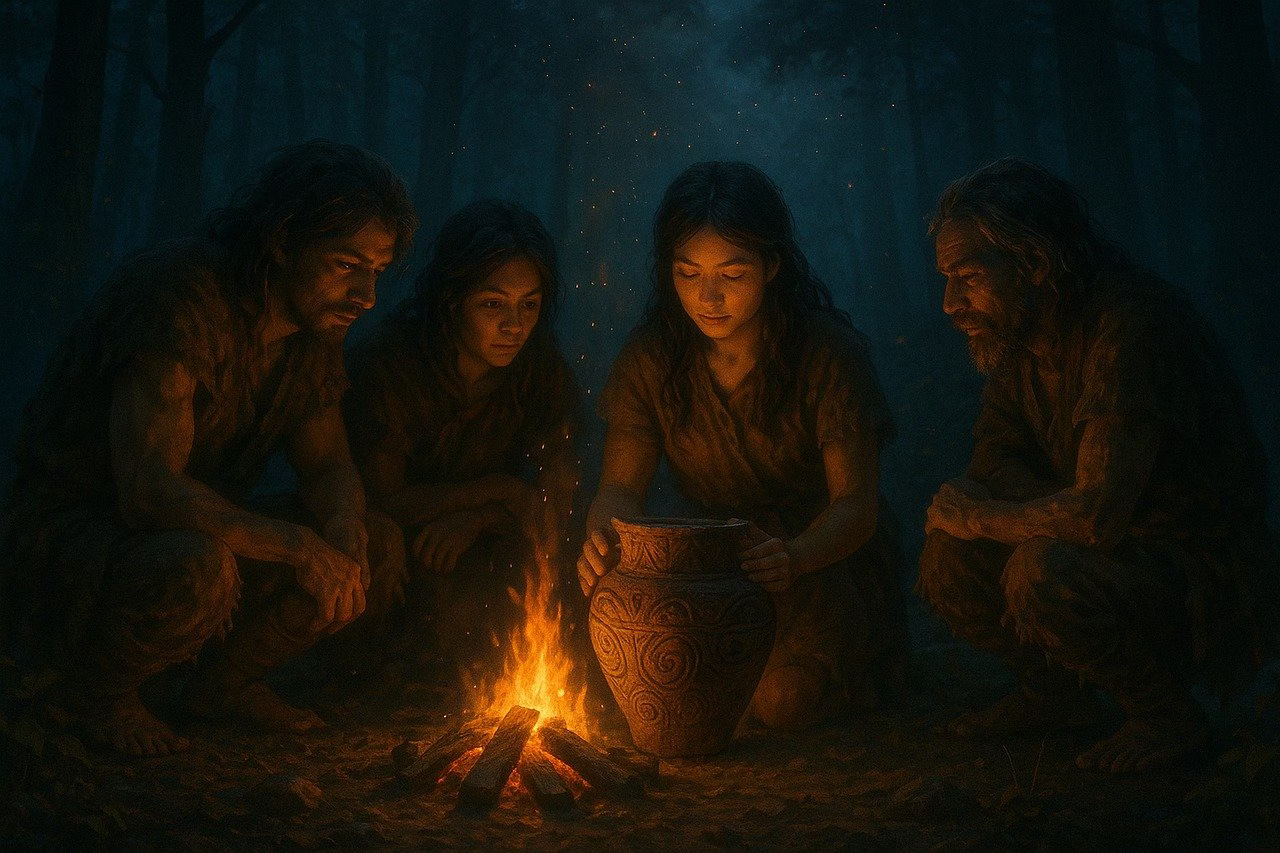
These were people who’d lost nearly everything. What they hadn’t lost, because it had not yet been taken from them, was each other. Not each other in the thin modern sense of being in proximity. Each other in the full sense: known, embedded, accountable, necessary to one another’s daily survival and daily joy. This is what a tribe is. This is what human beings lived inside of for the vast majority of the time we’ve existed as a species.
The Australian Aborigines have a phrase, “The Great Forgetting,” for what happened to European peoples over roughly the last two millennia as the old tribal structures were systematically dismantled by the British empire and then by the Catholic Church.
The sacred sites destroyed. The rituals banned. The languages absorbed into Latin and then into English and the national languages of nation-states. The commons enclosed. The grandmothers and grandfathers who carried the deep knowledge of how to live in a particular landscape, and how to live with one another, silenced or killed.
What was left, they know, was the outward form of a culture without its roots, people in tremendous numbers living side by side without any architecture for genuine belonging.
We don’t often tell this story when we talk about loneliness. We prefer to blame social media, or the pandemic, or smartphones, or the death of the third place. These things matter, but they’re just the symptoms.
The WHO report notes that loneliness kills as surely as smoking fifteen cigarettes a day. What it doesn’t ask is how it came to be that the default condition for hundreds of millions of people is a kind of low-grade starvation of genuine human contact, and whether that condition might have structural roots that run deeper than any app or urban planning initiative can reach.
The answer, if you look honestly at the anthropological record, is that we built a civilization optimized for productivity and consumption, and we did it by dismantling, piece by piece, everything that made human beings feel genuinely held.
The village. The extended family under one roof. The practice of sitting together in the evening rather than each retreating to a separate screen. The shared ritual that marked time and gave life its shape. The elder who knew your name and your history and could place you in a story larger than your own anxiety. None of these things went away because they were bad ideas; they went away because they interfered with the efficient production of workers and consumers.
I worked for years as a psychotherapist running a residential program for severely abused children, kids who’d been failed by every institution designed to protect them. What I saw, over and over again, was that the damage was not only what had been done to them; it was also what had never been provided.
Safety, yes. Food and shelter, yes. But beneath all of it, the absence of the sustained, unconditional, witnessed belonging that is the birthright of every child and that no therapeutic technique, however skilled, can entirely substitute for. You can heal a great deal. You can’t, however, manufacture a tribe after the fact and expect it to do what a tribe does when it’s the water a child has swum in from the beginning of her life.
This is not a counsel of despair. The drumming happened in the refugee settlement because the impulse toward community is not destroyed so easily. It’s biological. It’s written into us at a level that predates language or culture.
Researchers studying the neuroscience of loneliness find that it activates the same threat-detection circuitry as physical pain. This is not a coincidence: for most of human history, being separated from your group meant death.
The pain of loneliness is the nervous system’s alarm. We just built a world where the alarm goes off constantly and there is nowhere particular to run.
What this means practically is that the solutions worth trying are not the ones that make isolation more comfortable. They are, instead, the ones that re-create, in whatever scaled-down modern form we can manage, the conditions that the nervous system is actually asking for.
Not more social media followers, but more people who know when you’re sick and show up anyway. Not a longer list of connections on LinkedIn, but a smaller circle of people with whom you share actual obligations, actual history, actual meals.
The research consistently points toward exactly what every tribal culture already knew: that meaning and belonging are not separate things, that you can’t have one without the other, and that neither of them can be delivered through a screen or legislated into existence by a government commission.
The WHO is right that this is a public health crisis. But public health crises have causes, and the cause of this one is not a virus or a toxin. It’s a story we’ve been telling ourselves for ten thousand years about what civilization is for.
The good news is that stories can change. The drums are still in us, waiting.
Fabulous! You've captured in everyday language what I struggle with every day. From start to finish, this is truth telling about our 10,000 year catastrophe, of capture by immature bullies, service to power rather than health and happiness. It took 10,000 years to perfect the weapons of our mutual extermination, the 6th Mass Extinction. Can we reverse it, re-learn community in time?
How do we organize a technological society without hierarchies, or turn hierarchies into community-reproducing (not just "-friendly")? The answer comes from within each of us, and is untried, unconsidered, "lost in space", to be regained by trial-and-error. Regaining confidence in the possibility may be the first major hurdle.