
Twelve Was the Age I Built Treehouses
A new study from Children’s Hospital of Philadelphia confirms what many of us already suspected. The smartphone is not the right gift for a sixth-grader.

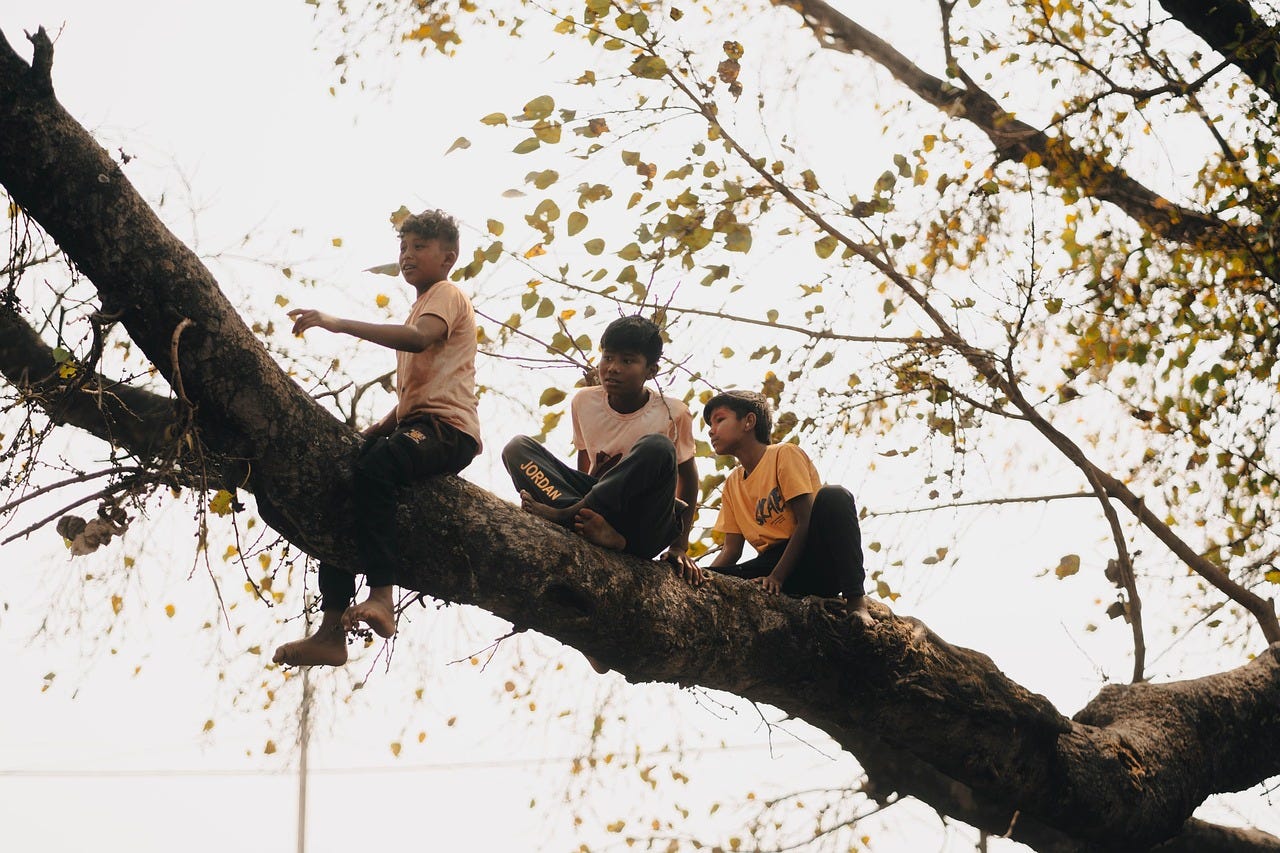
When I was twelve I had a bicycle, a Boy Scout knife, a library card, and what amounted to a couple of square miles of free range. My parents had no idea where I was most afternoons, and I had no real idea where they were either. We met up at dinner, told each other the day’s news, and went back out.
I built a treehouse with friends I’d known since first grade. I dammed a creek with rocks and caught frogs. I walked into the woods with no destination and came back when I was hungry. I read books up in trees. Some afternoons I was bored out of my mind, and that boredom was the soil in which I grew everything I’d later become.
A twelve-year-old today has a different life. The library card has been replaced by a piece of glass that knows them better than their grandmother does, that follows them to bed and wakes up before they do, and that has been engineered, with the same techniques I learned decades ago in advertising and broadcasting, to keep their eyes on it for as many hours as possible.
The treehouses are mostly gone. The creek’s fenced off or paved over. Free range, for most American kids, has shrunk to the distance between the bedroom door and the school bus, and even that distance is patrolled.
Now we have hard data on what that’s costing them. A study published December 1st in the journal PEDIATRICS by a team from Children’s Hospital of Philadelphia, working with researchers at UC Berkeley and Columbia, looked at over ten thousand American adolescents and found that owning a smartphone at age twelve is associated with higher rates of depression, obesity, and insufficient sleep.
The younger the kid was when they got the phone, the worse the obesity and sleep problems got. And in maybe the most damning finding, kids who reached twelve without a phone but then got one between twelve and thirteen had more mental health problems and worse sleep at thirteen than the kids who stayed phoneless.
That’s not screen time in general. That’s the smartphone specifically. The thing in their pocket. The thing in the dark beside their pillow.
I’m not surprised. I spent the early years of my career in advertising and broadcasting (writing copy, running radio stations, building ad campaigns for clients large and small) and I learned, the way every working ad person learns, how to manufacture wanting.
You learn the hooks. You learn how to plant a hunger that the product is the only answer to. You learn that attention is a finite resource and whoever captures it wins. None of that knowledge was secret. It was just the trade.
What’s different about the smartphone is that the techniques have been turned, full force, on children who’ve barely learned to read. Notifications are slot-machine pulls. Likes are dopamine reinforcers. Streaks are addiction-engineering. The endless scroll is a Skinner box you can hold in one hand.
None of that is metaphor. The people who designed these systems have been frank about it; many of them won’t let their own children near a phone, which is one of those small details that ought to be on the front page every day until the country wakes up.
What we’re discovering, study by study and casualty by casualty, is that there are developmental tasks a twelve-year-old’s body and mind absolutely have to do (move, sleep, wonder, get bored, fight with friends, make up with friends, walk in the woods, lie in the grass and look at clouds, have unsupervised conversations about the things twelve-year-olds talk about) and that all of those tasks are being displaced, sometimes silently and sometimes not, by the device.
My friend Joseph Chilton Pearce, in his beautiful book Magical Child, laid out what each stage of childhood is actually for. Each stage opens a window. If the window is open and the child gets what they need (movement, story, embodied experience, the felt sense of mattering to a real community), the window closes around a strong, integrated adult. If the window is open and the child gets a slot machine instead, the window still closes. Just not around what was supposed to be in there.
This is also where the Edison Gene comes in.
I’ve written for years about the kids we now call ADHD, the so-called hunters in a farmer’s world, the kids who learn through doing and moving and building and arguing and questioning rather than through sitting still.
Those kids are particularly catastrophic targets for the smartphone, because the phone hijacks the very systems (novelty-seeking, dopamine, immediate reward) that make a hunter-mind brilliant in the right environment and miserable in the wrong one. Hand a hunter-mind kid an infinite-novelty machine that punishes them every time they put it down, and you’ve built a private hell for the very child whose gifts the world most needs.
So what do we do? The study’s lead author, Ran Barzilay, is gentle about it, and I respect that. He notes that smartphones can do good things too: keep families in touch, give a lifeline to a queer kid in a rural town, help a curious mind learn anything they want. He’s right. I’m not arguing for phoneless purity.
I’m arguing for delay, and for rebuilding the village around the child. The two go together. You can’t take the phone away if there’s nothing else there. A bored, unsupervised, friendless twelve-year-old in a suburb where every other twelve-year-old is on a phone has nowhere to go but onto the phone too. That isn’t a choice the kid is making. That’s a vacuum the kid is filling.
The good news is that parents have started organizing. The American Wait Until 8th movement has signed up well over a hundred thousand families pledging together not to give their kids a smartphone until at least the end of eighth grade, on the simple insight that the pledge only works if your kid’s friends’ parents take it too.
Across the Atlantic, Smartphone Free Childhood launched in early 2024 from a single WhatsApp group in Suffolk and now has over three hundred thousand parents in its network, with offshoots in more than thirty countries.
School districts from Florida to California are banning phones from the school day, and the kids, after a couple of weeks of withdrawal, look up and notice each other again. Whole school cafeterias get loud again, the way cafeterias are supposed to be. Surgeon General Vivek Murthy made youth social media use an official public health priority back in 2023. Jonathan Haidt’s The Anxious Generation is on parents’ nightstands across the country. The conversation has shifted. The data is now in the chamber.
What I want to say to every parent, grandparent, aunt, uncle, godparent, neighbor, and teacher reading this is simple: delay the phone, and rebuild the village. Twelve is too young. Thirteen is too young. Fourteen is borderline.
And while you’re delaying, give them what twelve-year-olds actually need. Trees. Tools. Bicycles. Time. Other kids who aren’t on phones either. A grandmother to bake with. A trail. A creek. A book read up in a tree. A dinner table where the phones are face-down in a basket by the door.
The childhood you remember (or wish you’d had) wasn’t an accident of nostalgia. It was a setting in which a particular kind of human being could grow up. We can build that setting again. It just takes a few of us to start.
If there’s a kid in your life heading for that twelve-year-old threshold, share this piece with their parents. Send it to the grandparents. Send it to the teachers. Talk to two other families on your street and start your own little wait-until-eighth pact, even if you’re the first ones to do it. And tell me in the comments how it’s going. Some of the most useful wisdom on this site comes from your stories, not mine.
I was also that 12-year-old, doing the same things here in the UK. Sad to see them go and what it has done to younger generations.