


I remember a summer when I was around five or six years old. My parents had recently purchased a hammock and put it in our backyard, and I was lying on it on a bright sunny afternoon. The sky was a deep blue, with thin wispy clouds, and I could smell the fresh-mowed grass crushed by the green-painted metal frame of the hammock.
I could feel the ropes of the hammock against my back through my T-shirt and pressing against my bare legs below my shorts, and hear the melodic sounds of birds singing in the trees that surrounded the yard. One of the birds was repeating over and over a three-note call, while others chirped randomly.
I wondered what they were saying, and to whom. Over the years since, that question has hit me again and again; the natural world around us is alive, but how “conscious” are our fellow beings?
One of the assumptions of our culture — that was particularly amplified by René Descartes 1645 notion of the world as, essentially, a giant machine with us being the only living things in it (the so-called “Cartesian worldview”) — is that we’re the only beings on this Earth who really have understanding and can derive deep meaning from communications with each other.
When we talk with each other, our words evoke pictures, memories, and meaning in each other’s minds. We can put those into context, assign or derive significance, etc. Our culture’s assumption about animals, however, has always been that they’re simply communicating “triggers” for behaviors: run away, fight, eat, sex, etc.
When a bird chirps, for example, are other birds who hear them simply reflexively, instinctively responding mechanically? Like a “danger” call provokes them to look around so they’ll catch the source of the danger?
Or when a bird hears another bird’s chirp is it, instead, receiving an idea and responding to the complexity of that idea, rather than simply and mechanically responding like in a way that’s really more of a reflex than a response to an idea, a mental concept?
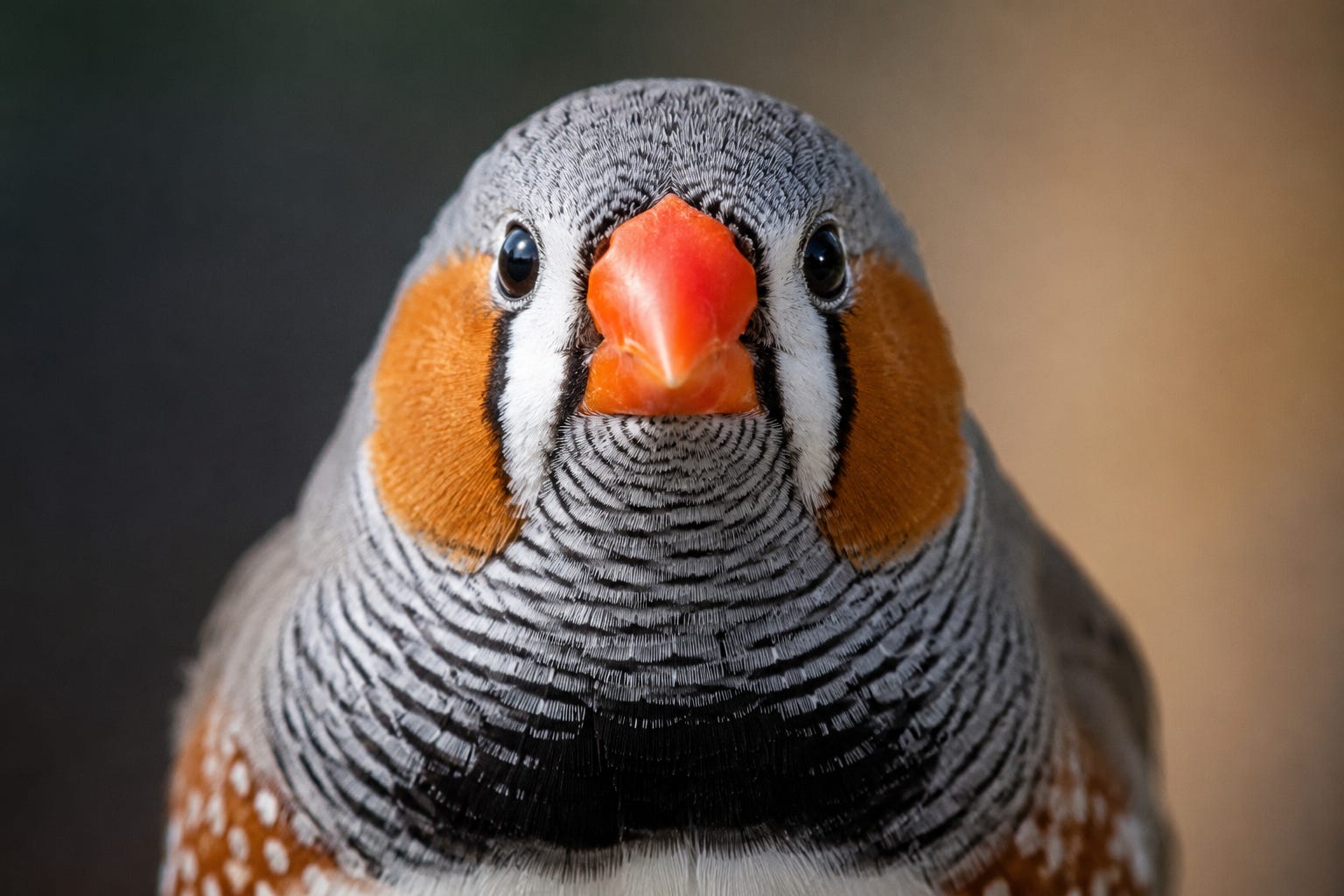
That was the question that Dr. Julie E Elie and her colleagues set out to answer using zebra finches, little birds with a repertoire of 11 specific calls. Their work was extraordinary and detailed, and you can read the entire study here, but to summarize it, what they found was that the birds are not responding to calls as a reflex, but rather were communicating actual ideas and concepts to each other.
These little tiny birds, with their little tiny brains, in other words, were engaging in what we call cognition rather than what we’d mistakenly though for six hundred years, that they were simply acting out conditioned responses either learned from their parents or wired into them by evolution.
The entire world is not only alive and speaking to us all the time, at every level, but at least for animals that speech has meaning. We’re not surrounded by little robotic machines but, instead, smaller versions of ourselves, capable of both conceptualizing an idea, communicating that idea, and responding to that idea.
As one of her colleagues, UC Berkeley professor of neuroscience Frédéric Theunissen, noted:
“We have shown, indirectly, that [these] birds understand what they are saying.”
That’s also a foundational concept among pagans and pantheists: everything is alive and we’re simply a part of a remarkable web of life.
Louise and I were climbing a small mountain here in Portland’s Forest Park last weekend, and as we walked (and got seriously out of breath!) she pointed out how most of our religions today carry Descartes’ worldview, overlaid with patriarchy and rationalizations for division and violence.
“I’d rather identify with the pagans,” she said, “who saw life and intelligence — what you might call divinity — in everything from plants and animals to rivers, mountains, and oceans.”
We’ve built an entire civilization around the bizarre concept that we’re the only things on this planet that genuinely think and feel. It allows us to rationalize treating other animals with brutality — think factory farms — and despoiling our environment. After all, we humans are the only ones who really think and feel, right?
When older cultures tried to tell us this concept was wrong — that it was a form of wetiko mental illness, in fact, as I detailed in The Last Hours of Ancient Sunlight — we ignored them and paved over the world, bulldozing whatever got in our way.
Dr. Elie won a $100,000 prize for this work, the Coller Dolittle Challenge for Two-Way Interspecies Communication. It’s groundbreaking and another little step in chipping away our Cartesian myths and realizing that, ultimately, all life on Earth is both interconnected and conscious.
Reading this made me almost cry...must have reached a deep place.
I have always felt part of "allness." The most Natural feel in the world to me. Greatly appreciate this article and your mention of wetiko!
I'm with Louise 👇
“I’d rather identify with the pagans,” she said, “who saw life and intelligence — what you might call divinity — in everything from plants and animals to rivers, mountains, and oceans.”
YES, Allness.