


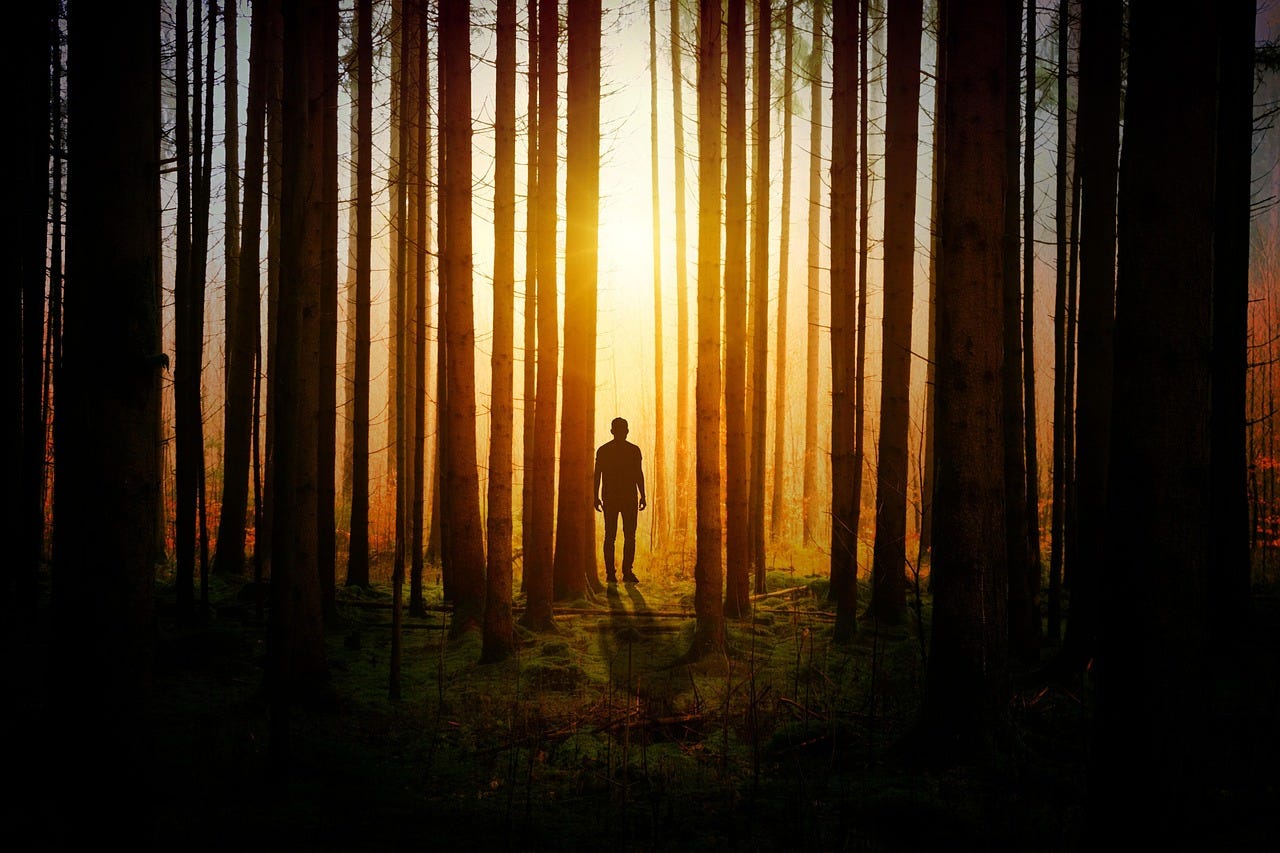
Walk into a piece of old growth Pacific Northwest forest, and something happens to you. The light goes liquid. The air thickens. The moss is six inches deep on every horizontal surface. The Doug firs go up two hundred feet without a branch and disappear into a canopy you can’t quite see. The fallen trees, what loggers used to call nurse logs, are slowly becoming the next forest, with seedlings already rooted in their soft, decaying bodies. And the silence isn’t really silence. It’s a different quality of attention than you can find anywhere else.
I’ve spent a lot of hours in those forests over the years. What strikes me, every time, is that the forest doesn’t feel like a place. It feels like someone. Or, more accurately, like many. A standing community of beings that knows you’re there before you know how you feel about being there.
For most of my life, science was telling me I was wrong about that. The official story, survival of the fittest, was that a forest is a kind of slow-motion gladiator pit, every tree fighting every other tree for sunlight and water and nutrients, and that the canopy I was walking under was the result of a few million years of relentless mutual exploitation. Whatever I was feeling under those firs was a poetic projection, not a fact about the forest.
In April, scientists from the Smithsonian Tropical Research Institute and the ForestGEO global research network published a paper in Nature that’s quietly demolishing that story.
The team examined nearly three million individual trees, across more than five thousand species, in seventeen forests spanning Asia, Africa, and the Americas, and they found that positive, supportive interactions between neighboring trees are at least as common as the competitive ones we were taught about in school, and that the closer a forest is to the equator, the more cooperative its tree-to-tree relationships tend to be.
“Most research has focused on competition and other negative interactions among trees,” the study’s co-author Matteo Detto said, “but trees can also help their neighbors in many ways. We find that these positive interactions are more common in tropical forests, adding another piece to the puzzle of understanding their remarkable diversity.”
This is on top of decades of research, by Suzanne Simard at the University of British Columbia and by many others, on the underground mycorrhizal networks (the so-called wood wide web) that connect tree roots through filaments of fungus, allowing them to swap carbon, water, nitrogen, and chemical defense signals across species lines.
Simard’s framework, including her concept of mother trees (older, larger trees that appear to act as hubs in the underground network), has been beautifully popularized in books like her own Finding the Mother Tree and Peter Wohlleben’s The Hidden Life of Trees, and has also, in fairness, been challenged by other ecologists who argue that some of the popular claims have run ahead of the data.
The careful version of the science, today, is this: forests are unmistakably interconnected through fungi and roots, carbon and signals do move among trees through those networks, big old trees do appear to play structural roles in the system, and the precise mechanisms of how, and how much, are still being worked out. What’s not in question, after the new Nature paper, is the larger frame. Forests are cooperative systems at least as much as they are competitive ones. They’re not gladiator pits. They’re communities.
This matters far beyond ecology, because for the last hundred and fifty years our entire economic worldview has been built on a stolen metaphor from biology. We took Darwin’s struggle for existence, ripped it out of its context, ignored the fact that he wrote at least as much about cooperation and mutualism as he did about competition, and built capitalism, libertarianism, and most of our public-policy frameworks on the assumption that competition is the law of nature.
We lectured each other about it for generations. We told the kids in our schools that the forest was red in tooth and claw. We told them the market was just an extension of the forest. We told them anyone who didn’t make it deserved their fate, because that was just how nature worked.
But nature doesn’t work that way. The Russian biologist Pyotr Kropotkin, observing wolves and birds and human peasant villages across Siberia in the 1880s, noticed this immediately and wrote his classic Mutual Aid to push back on the social-Darwinist misreading of his contemporary, Thomas Huxley.
Lynn Margulis, a century later, blew the whole story open with her work on endosymbiosis, demonstrating that the eukaryotic cell, the basic unit of every plant and animal on Earth, came into existence through cooperation between two ancient bacteria, not through competition.
And forest ecology is now arriving at the same place. The trees, it turns out, are not in business school. They’re in a long, patient, multispecies relationship with their neighbors, their fungi, their soil, their rain, their light, and the dead bodies of every tree that ever lived and fell among them.
I made a related argument decades ago in Last Hours of Ancient Sunlight. The whole basis of life on Earth is a single, vast, hundreds-of-millions-of-years-long cooperative project.
Photons from the sun cooperate with chlorophyll. Chlorophyll cooperates with carbon dioxide and water. The resulting sugars cooperate with mitochondria. Plants cooperate with fungi. Fungi cooperate with soil. Soil cooperates with microbes. Trees cooperate with other trees.
And for almost all of human history, every culture except the most recent one understood this implicitly. The forest was a relative. The river was a relative. We were not above the system. We were part of it, and our job was to maintain the relationships that kept it alive.
What does this mean for the rest of us in 2026, with a planet on fire and a civilization built on the wrong story? Three things, I think.
First, defend the old growth forests we have left. They aren’t interchangeable with tree plantations. A two-hundred-year-old Doug fir, with its underground mycorrhizal partners and the centuries of local relationships it has built, can’t be replaced by twenty saplings on a clearcut. Once those connections are severed, it can take centuries for the network to rebuild, if it can be rebuilt at all. There’s a reason indigenous land sovereignty consistently produces healthier forests than corporate or state management does. Indigenous knowledge has known this in its bones for thousands of years.
Second, change the story you tell yourself about how the world works. Adam Smith was wrong about the invisible hand being our deepest nature. The forest is the deeper truth. Cooperation, mutualism, kinship, and care are the substrate. Competition is real, but it sits inside the larger frame of cooperation, the way a jazz solo sits inside the band.
If you build a society on the metaphor of the forest instead of the metaphor of the market, you get a different country, with different schools, different hospitals, different elder care, different economics, and very different relationships between neighbors.
Third, find a real forest, an old one if you can, and sit in it for an hour with your phone face-down. Not to perform contemplation. Just to listen. The forest will teach you what cooperation actually feels like, in your body, with no theory required. You’ll feel small in the right way, and held in the right way, and you’ll come out of it remembering something the dominant culture spent a century trying to make you forget.
The new Nature paper is just the latest piece of the science finally catching up. The forest was never a battlefield. It’s a community we forgot we belonged to. And the very good news is that the community is still here, still patient, still willing to teach us, in the language of light and root and fungus, who we actually are.
If there’s an old growth forest within driving distance of you, go this month. If there’s a campaign to protect it, donate or volunteer. If your local government is making decisions about a nearby greenbelt or watershed or working forest, show up at the meeting and speak. And tell me in the comments where your forest is, and what it’s teaching you. We’re a wisdom school here, which means our forests, like our wisdom, belong to all of us.
I was raised in a family whose homes were mostly among second growth redwood trees--over 100 years old with the old growth stumps. When I was dealing with the English Ivy that took over the forest, if I let it, I discovered that the remaining old growth stumps still had roots connected to the younger trees. Yes, the Mother trees were still operational. And, yes, I am just finishing Simard's book, The Mother Tree. I
A very profound article. This needs to be widely read. Thank you for this.